

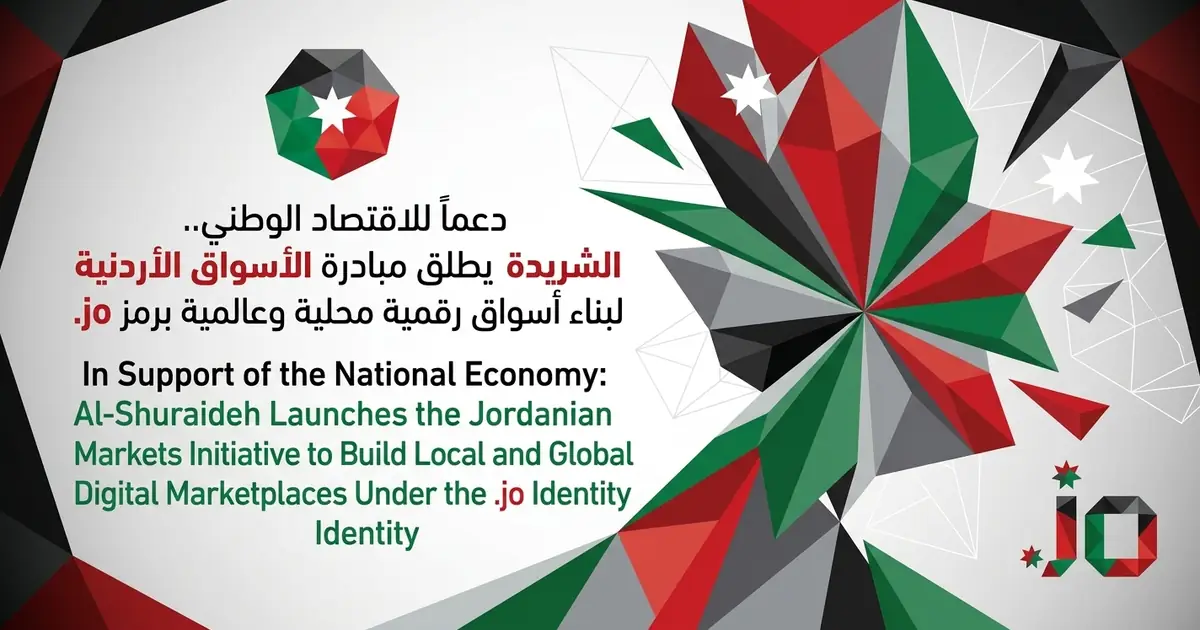
Further to the Jordanian Markets Initiative: Data Security and Sharing Boundaries via the Unified Software and Arabic Curricula
3. Data Security and Sharing Boundaries via the Unified Software The technical and regulatory model of the initiative focuses on data security by establishing precise regulatory and programmatic boundaries for sharing, without the need for complex encryption layers that hinder workflow or increase operational costs:
- Defining Data Sharing Boundaries: Restricting data exchanged through the unified merchant software to basic, public commercial information (such as: shop name, national registration number, specialization, location, product details, prices, and direct contact numbers).
- Preserving Data Context and Exchange Speed: Fine-tuning software mechanisms so that only the information necessary to complete display, sales, and delivery transactions is exchanged, ensuring transparency between seller and buyer without exposing data to dispersion.
- Organized Geographic Tracking: Linking the shop address with a Quick Response (QR) code and the five-tier coding system (Governorate <- Specialization <- Area <- Street <- Building Number) to facilitate delivery services and track shipments via digital maps simply and free of charge.
Continuation of the Initiative: From Theory to Framing — The "KarakCode" Platform as a Foundation for Launching the Unified Software Construction Path
Introduction: Programmatic Foundation of Data Sovereignty and National Roots
The Jordanian Markets Initiative was never merely a theoretical vision to structure digital commercial operations; rather, it was established to reinforce the concepts of digital sovereignty, fair trade, and data security without burdening local businesses with operational overhead or excessive encryption complexities. This vision integrates with the technical curriculum and practical skills, drawing upon foundational references such as the Debian distribution handbook for building secure and stable servers.
With the official launch of the KarakCode website on October 12, 2026, we announce the commencement of the first phase of this path. This launch does not represent the attainment of the final goal; rather, it signifies establishing the approach and launching the technical and regulatory umbrella under which we will work to achieve the ultimate goal: building and developing the unified software for Jordanian markets. In this journey, we rely on an integrated Arabic technical stack that combines the stability of the Debian environment, the precision of version control and tracking modifications through a version control system—which serves as the backbone of reliable collaborative work for Jordanian programmers—and the robust flexibility of the Django framework in application development and user data protection.
First: Key Concepts Extracted from the KarakCode Platform as a Starting Point for Building the Unified Software
- Authenticity and Heritage-Inspired Design: The platform adopts the slogan, "Our craft is tech, rooted in authentic Jordanian heritage." It draws the robustness of its software infrastructure from the walls of Karak Castle, the precise organization of its code and lines from Madaba mosaics, and the fluidity of its digital interfaces from the stone carvings of Petra.
- Digital Resilience and the "Nubian Ibex" Concept: The platform highlights the Nubian Ibex as a national and cultural symbol of balance, determination, and resilience in rugged terrains. Technically, this concept reflects the engineering approach required to build the unified software: lightweight, agile, and resilient systems capable of operating with high efficiency on minimal resources and maximum reliability without being affected by external fluctuations.
- Adopting the Technical Umbrella and a Call for Collaborative Work:
The platform was launched to embrace the approach serving Jordanian markets, documenting the vision and technical orientation at
[https://github.com/shrideh/karakcode](https://github.com/shrideh/karakcode). This aims to make the vision and broad outlines accessible to all, enhance transparency, and open the door for Jordanian developers and programmers to unite and work collaboratively to build the unified software step by step. - Integration of Digital Services for Merchants and Individuals: The platform delivers the initial foundational building blocks for e-commerce platforms, web development, Arabic UI/UX design, and visual brand identities inspired by Jordanian heritage.
Second: Operationalizing "Data Security and Sharing Boundaries" as a Precursor to the Unified Software
The KarakCode platform practically translates the initiative according to the three approved data security axes to serve as the governing guide for building the unified software:
- Restricting Exchanged Data to Basic Public Commercial Information: Framing databases in the target software to eliminate the collection of complex private data or invasive user tracking; instead, models rely on restricting exchanged data to direct service information:
- Business name and national registration number.
- Location, specialization, product details, and pricing.
-
Direct communication channels (e.g., email and phone).
-
Preserving Context and Accelerating Information Exchange: Utilizing a stable Debian environment equipped with advanced network security, alongside Django's built-in security mechanisms against vulnerabilities, to scale down data transmission so it is strictly confined to completing direct display and ordering transactions without the need for intermediaries who aggregate data or drive up operational costs.
- Five-Tier Geographic Tracking and QR Integration: Adopting a free and direct five-tier spatial coding system within the unified software without relying on paid or complex mapping services:
- Five-Tier Coding Sequence: Governorate <- Specialization <- Area <- Street <- Building Number Linked directly to a dedicated QR code for each shop, this enables merchants and delivery services to easily and accurately pinpoint addresses at no cost via digital applications.
Third: The Arabic Curriculum and Sustainable Software Empowerment for Building the Unified Software
Connecting the initiative with the technical curriculum and scientific foundations represents an engineering action plan directed at Jordanian programmers to build the unified software, relying on the following official educational references:
- Debian Handbook (Official Reference for Server Setup):
[https://www.debian.org/doc/manuals/debian-handbook/](https://www.debian.org/doc/manuals/debian-handbook/) - Version Control System (Official Documentation Website for Collaborative Code Management):
[https://git-scm.com/doc](https://git-scm.com/doc) - Django Framework (Curriculum and Official Documentation for Platform Building):
[https://docs.djangoproject.com/](https://docs.djangoproject.com/)
This educational and technical framework ensures the achievement of the following primary objectives:
- Infrastructure Independence: Operating the unified software upon completion on secure, hardened local servers.
- Framing Collaborative Work for Jordanian Programmers: Unifying efforts and coordinating through version tracking tools to build the unified software core.
- Empowering Shop Owners and Small Businesses: Accessing a tool that allows them to manage their products easily and around the clock once ready.
- Transparency and Digital Sovereignty: Making the building and development process clear and accessible within national frameworks.
Conclusion
The launch of the KarakCode platform is merely the starting point and foundational pillar through which we declare the approach and technical umbrella under which the collaborative work of Jordanian programmers converges to achieve the ultimate goal: building the unified software. By merging national identity and heritage with modern software engineering and security standards, and fostering the collaborative work of Jordanian programmers, we lay the foundational stone to empower shop owners and small businesses in the future to manage their products easily and around the clock via a secure, lightweight, and independent digital infrastructure.