
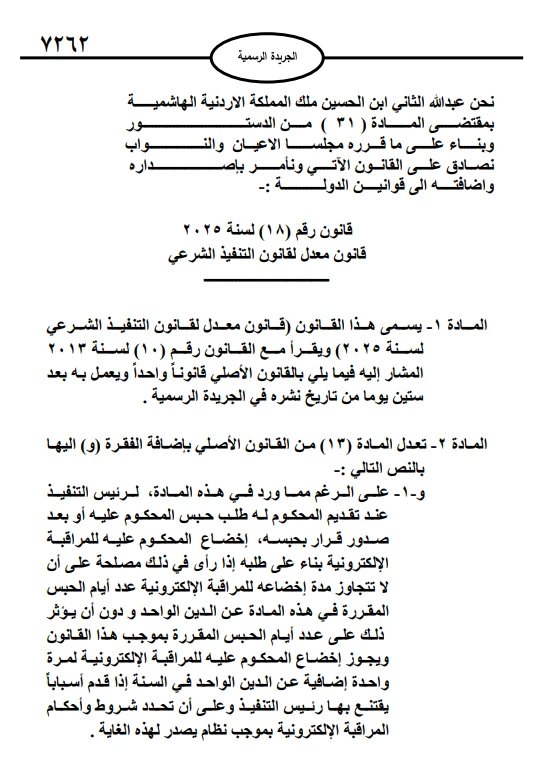
The Amended Law to the Sharia Execution Law No. (18) of 2025 was issued in the Hashemite Kingdom of Jordan as an important legislative step aimed at developing Sharia execution procedures and achieving a balance between the rights of creditors and the protection of judgment debtors, particularly in financial cases.
Publication in the Official Gazette
The amended law was published in the Official Gazette, Issue No. (6026), dated 31/12/2025. Accordingly, the law became part of the Jordanian legislative system after completing all constitutional requirements and being issued by Royal Decree.
Publication in the Official Gazette is an essential condition for the law to take legal effect, in accordance with the provisions of the Jordanian Constitution and general legislative principles.
When Does the Amended Law Come into Force?
The law explicitly provides that it shall enter into force after the lapse of sixty (60) days from the date of its publication in the Official Gazette. This period allows judicial and executive authorities, as well as lawyers and litigants, sufficient time to review the amendments and prepare for their practical implementation.
Key Features of the Amendment to the Sharia Execution Law
The amendment targets Article (13) of the original law by adding paragraph (W), which regulates executive detention and the possibility of subjecting the judgment debtor to electronic monitoring as an alternative to imprisonment, under specific terms and conditions, most notably:
- Granting the Head of Execution the authority to replace imprisonment with electronic monitoring upon the request of the judgment debtor.
- Limiting the duration of electronic monitoring so that it does not exceed the number of imprisonment days prescribed for a single debt.
- Ensuring that creditors’ rights and execution procedures are not adversely affected.
- Allowing the judgment debtor to be subjected to electronic monitoring one additional time per year for the same debt, provided that justified reasons are accepted by the Head of Execution.
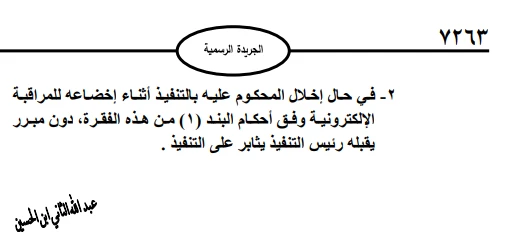
- Regulating cases where the judgment debtor breaches the conditions of electronic monitoring, without affecting the continuation of execution procedures.
Importance of the Amended Law
The significance of this amendment lies in its ability to:
- Keep pace with modern developments in execution mechanisms.
- Reduce the social and economic consequences of executive detention.
- Preserve creditors’ rights while ensuring the continuity of execution procedures.
- Promote a more humane approach to justice without undermining the authority of the judiciary.
Conclusion
The Amended Law to the Sharia Execution Law No. (18) of 2025, published in the Official Gazette, Issue No. (6026), dated 31/12/2025, represents a substantial legislative development in Jordanian law. The law enters into force after sixty (60) days from its publication date, marking a new phase in regulating Sharia execution procedures with greater flexibility and balance.